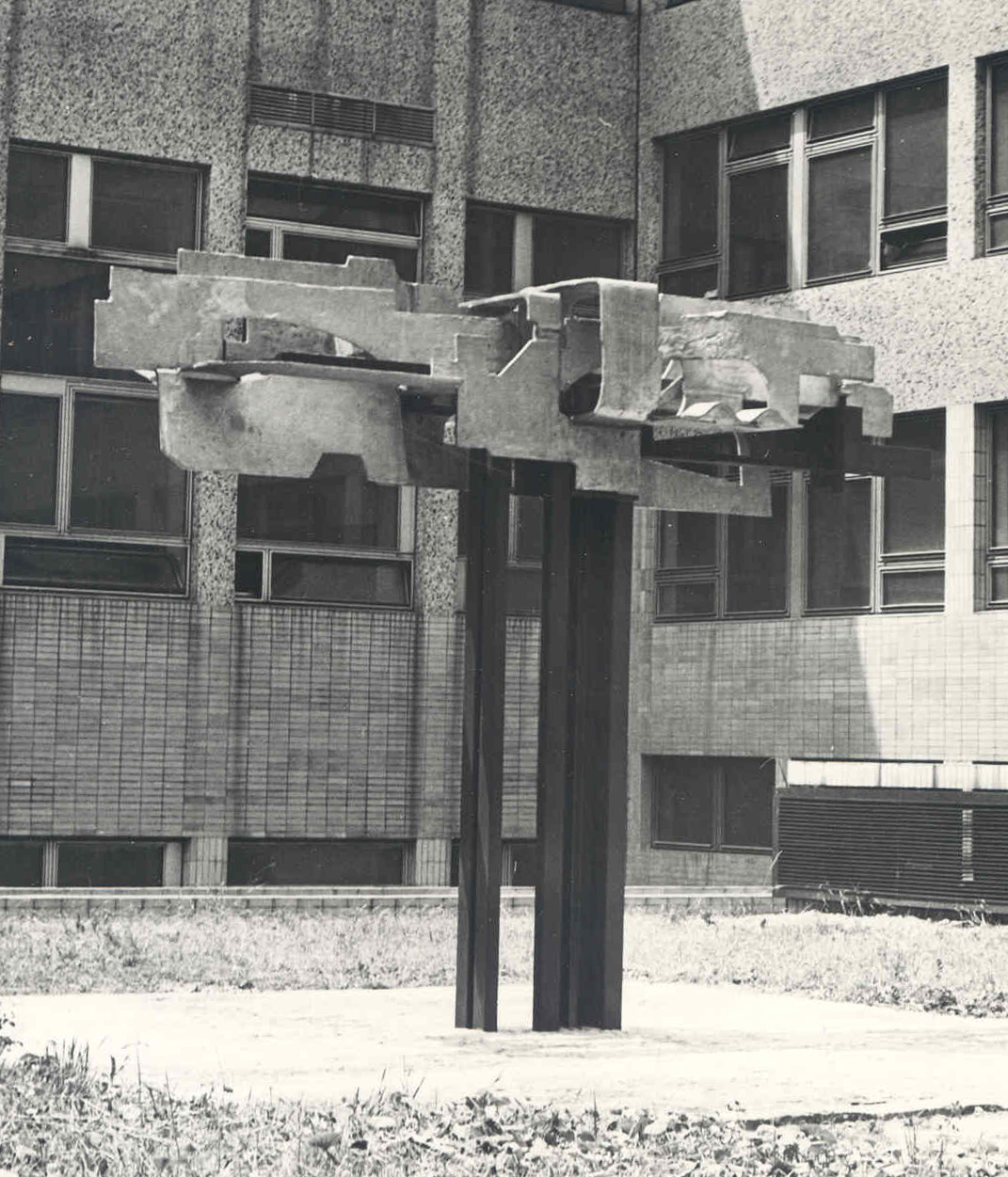
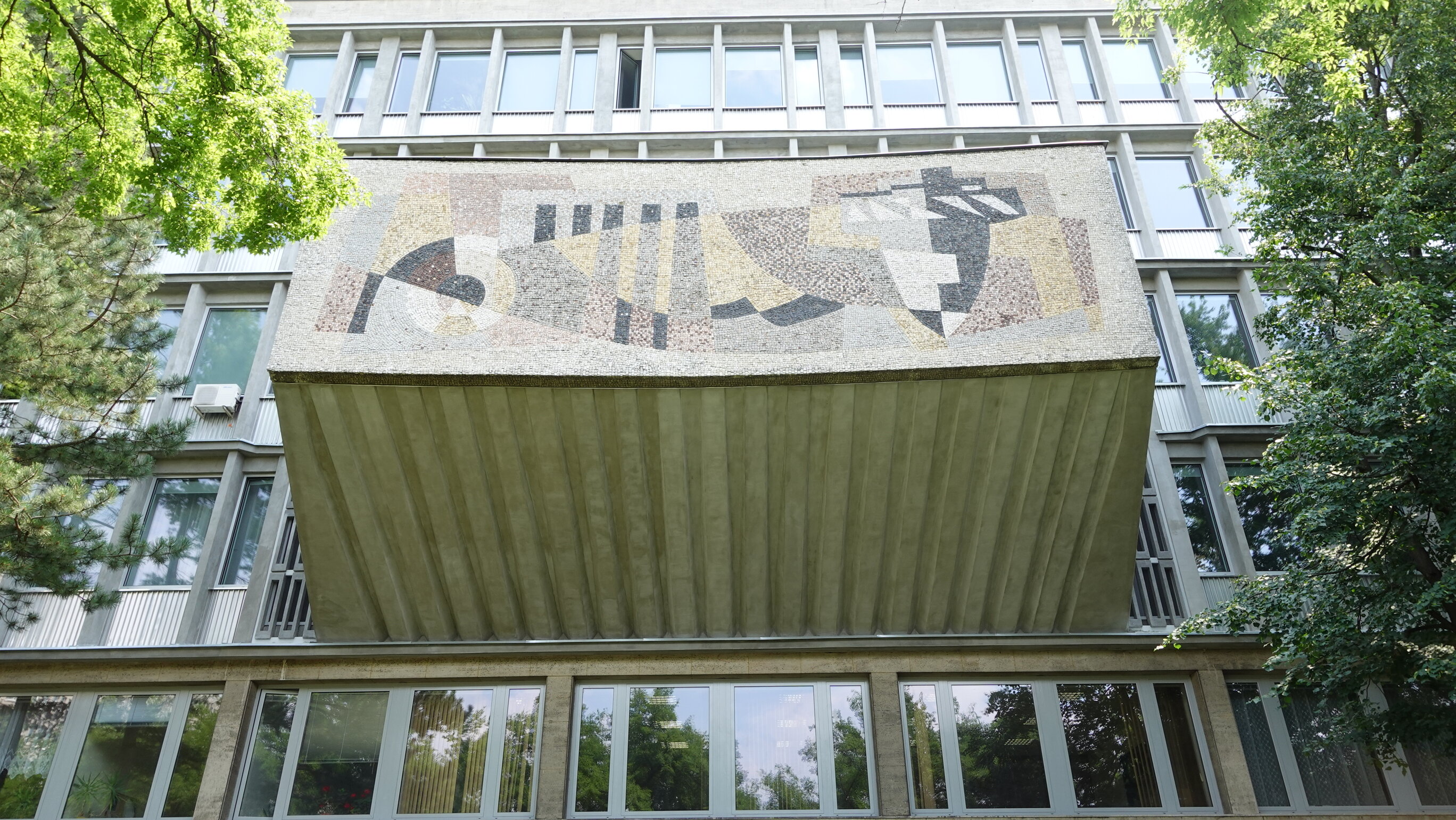
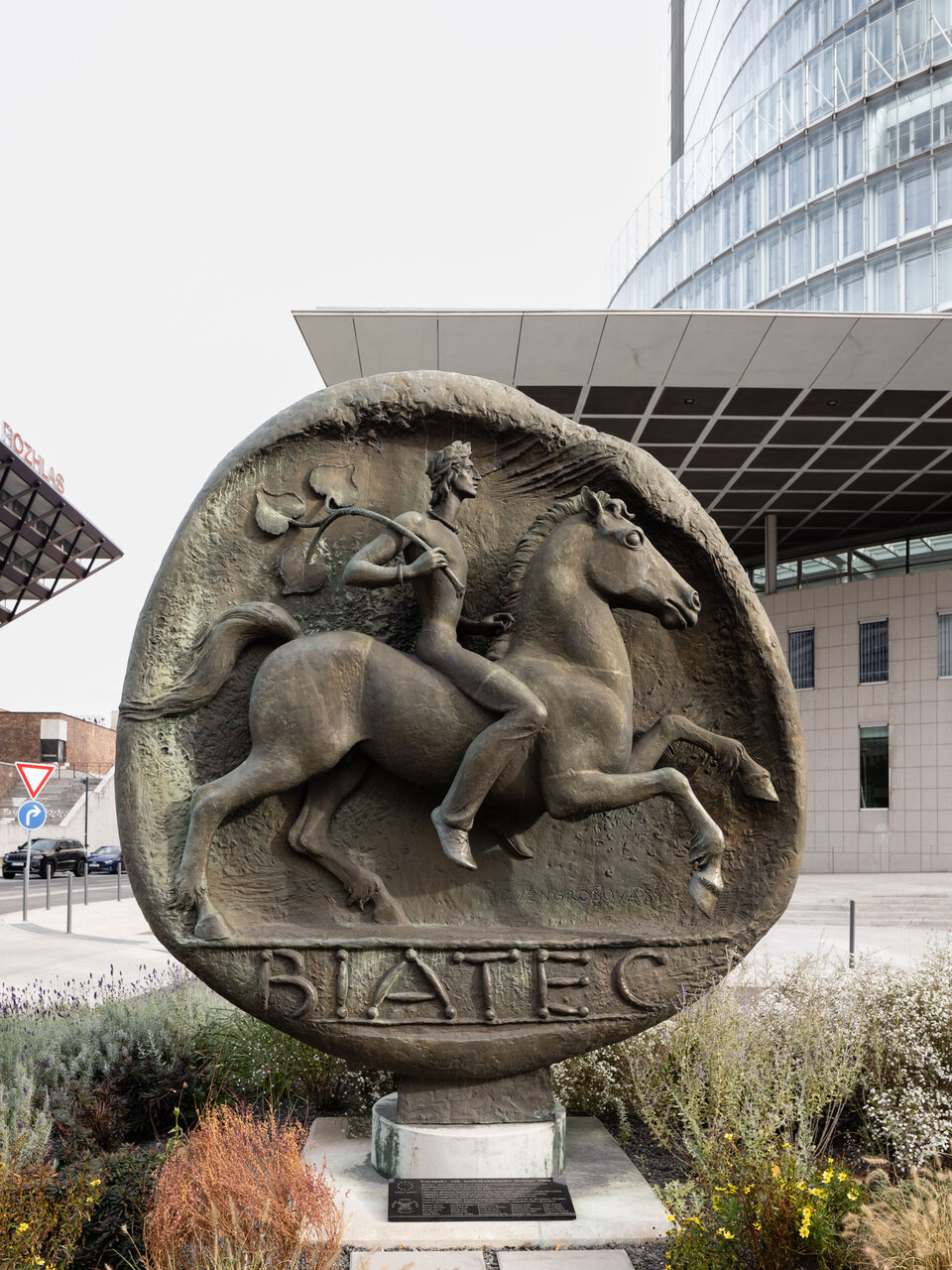
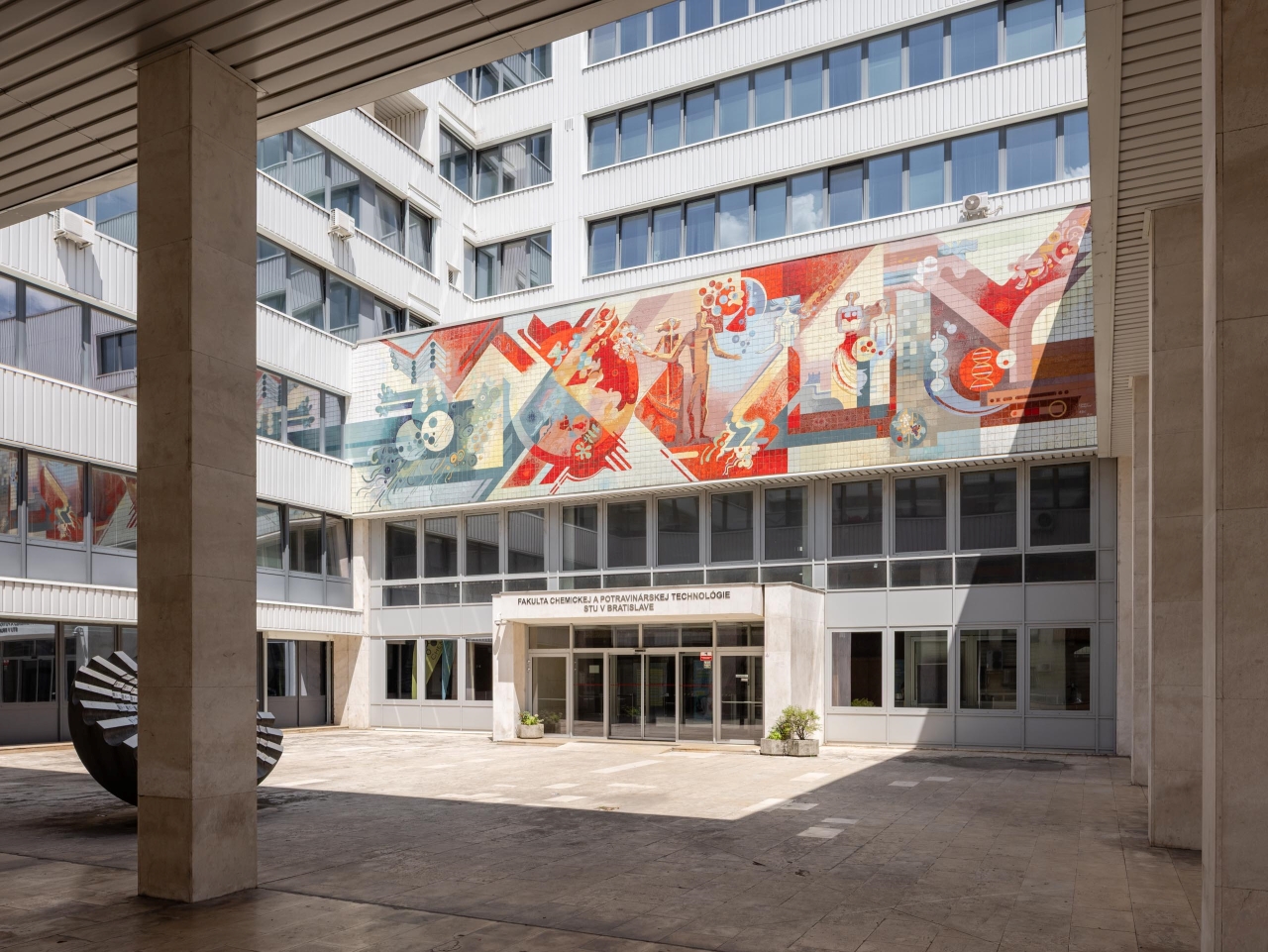
A recurring motif in the work of Ludwik Korkoš was a pair of seated women with symbolic attributes engaged in conversation. Usually, his aim was not to depict specific individuals, but rather to capture the archetype of the Slovak woman, transcended to the realm of an allegorical figure. With such intention, he designed a sculpture for the large atrium of the Faculty of Civil Engineering at STU, a work that is set on an orthogonal pedestal within the paved area of the relaxation zone.
The sculpture depicts two female figures dressed in traditional folk costumes and wearing bonnets. They hold a branch, a symbol of peace, and thus express this universal ideal. Despite being rooted in traditionalism, the figures display an inventive approach to geometric stylisation through their formal aspects. The cubist style, expressed in faceted surfaces and sharp edges, draws inspiration from the folk woodcarving tradition. The lower edge of a female figure's skirt bears the inscription: CAST IN UR BRATISLAVA 1976.
The Faculty of Civil Engineering at STU (SVŠT) was built between 1963 and 1974 according to a design by O. Černý. The low-rise structure with its two atria was connected to the Faculty of Mechanical Engineering, a building designed by Prof. M. Kusý, while the high-rise structure housing the various departments became the architectural centrepiece of the complex. Construction of the Faculty of Civil Engineering also served to enclose the STU campus on the side that faces today’s Freedom Square and Imrich Karvaš Street, creating a shared courtyard that unfortunately now only functions as a car park and storage area.
NB
Research status as of 28. 06. 2024.