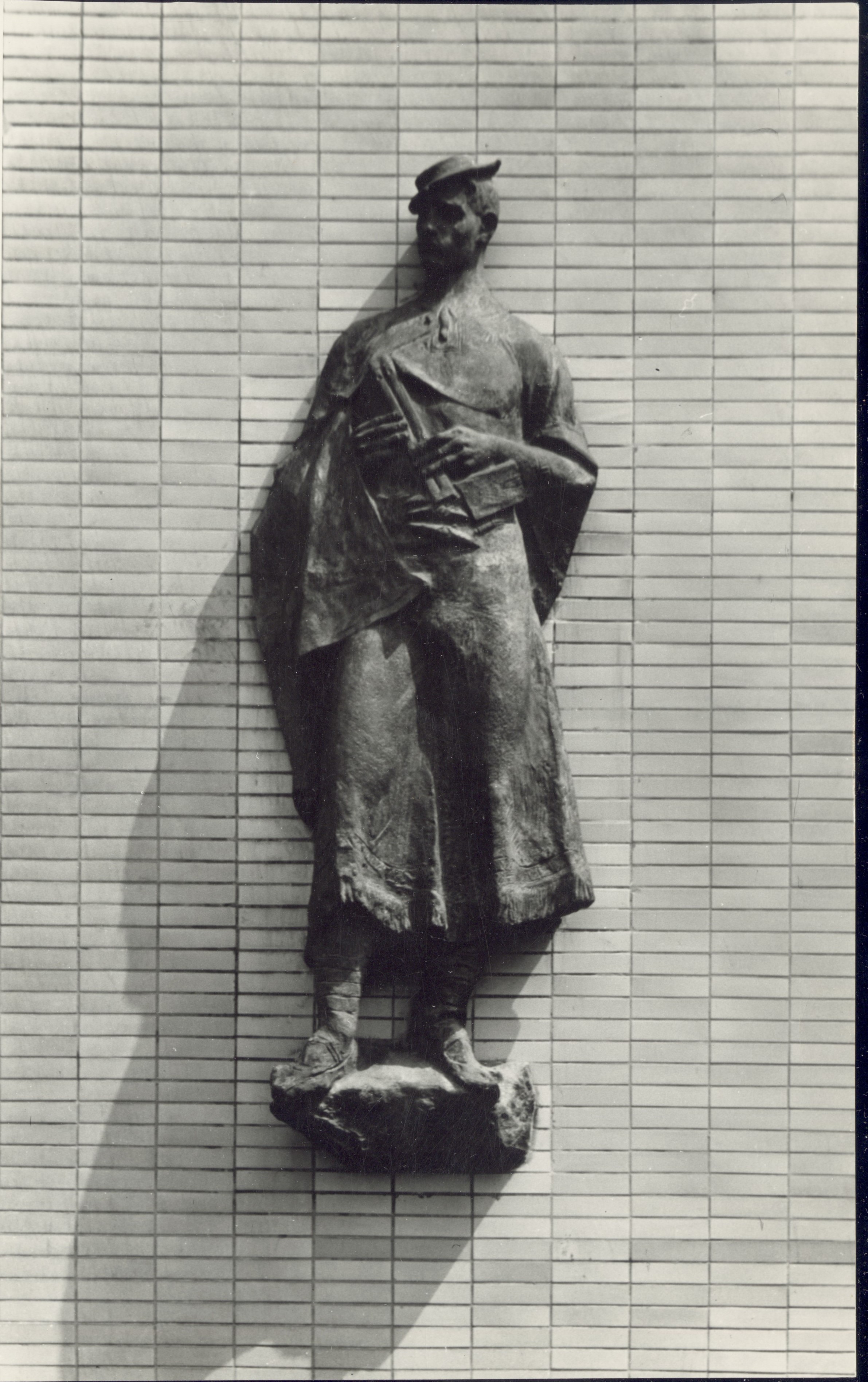
The Park of Culture and Recreation (PKO) was a large complex on the historic banks of the Danube. The exhibition complex was originally intended to host the International Danube Trade Fairs. Its design emerged in 1940 from a competition won by the architects Ján Štefanec, Pavol Andrik, and Kamil Gross. Following the Second World War, the construction project was modified and completed to meet the requirements of the newly established PKO. It hosted fairs and cultural, social, and sporting events, as well as political events of the time. The complex also included facilities for children's clubs, gyms, and various sports grounds. The first to open was the Variety and Social Hall (ABC Pavilion) in 1954, initially on a temporary basis. By virtue of a design competition for the artistic enhancement of the PKO, the hall was adorned with works of art that included stained-glass windows by Janko Alexy, the large-scale painting Harvest Festival by František Gajdoš, and a monumental fountain installed in the lobby. The competition also produced two sculptures: Poetry – Marína by L. Korkoš and Man from Detva by Tibor Bártfay. In 1957, these works were mounted symmetrically on the entrance façade of the Variety and Social Hall. The sculptures are designed in the spirit of socialist realism. They typically evoke youth, yet at the same time draw thematically on earlier literary traditions and folklore. Each artist later developed their own distinctive style.
The statue Poetry – Marína depicts a young woman in a stylised summer dress. She holds a piece of fabric (a scarf) gathered into rich folds, which lends the figure a sense of movement. The woman's face is turned slightly toward the building's entrance. Her hair, tied back in a braid, is adorned with a woven wreath. Although older sources refer to the statue as Poetry, the name Marína later became widely used, as did a combination of both names (as with the popular fountain on Šafárik Square). Since the counterpart to this statue is Man from Detva by T. Bártfay, both statues evoke the poetry of Andrej Braxatoris Sládkovič and his most famous poems: Man from Detva and Marína.
The somewhat unusual material used for both of these large-scale works is durable ceramic clay – terracotta. Owing to this, they occupied the façade in reasonably good condition for almost sixty years. Without professional maintenance, however, they could not withstand weathering or mechanical damage. A piece of the woman’s arm had broken away some time ago, and further damage was visible even from ground level. Despite the PKO’s popularity and potential for future use, its then-owner and operator Bratislava the Capital City of Slovakia had long neglected the complex. Eventually, undeterred by protests from the cultural community, the situation led to the site – first the land and then the buildings – being sold to developers, who began demolition in 2018. Some of the PKO’s artworks, interior furnishings, and design elements were saved and deposited in the Bratislava City Museum (MMB), the Bratislava City Gallery (GMB), and the Slovak Design Centre (SCD). The two sculptures from the façade of the PKO Variety and Social Hall are currently housed in the Bratislava City Gallery.
ZD
Research status as of 30. 04. 2024.