On a large plot of land between Dunajská and Grösslingová streets (formerly Red Army Street), older buildings were demolished and a multifunctional bank and apartment building was constructed according to a design by the prominent Slovak architect K. Paluš. A branch of the then Czechoslovak State Bank (ŠBČS) was opened in the lower section of the building, its raised ground floor facing Dunajská Street. A residential tower block with 44 apartments stands at the centre of the plot. The building complex is interconnected by atriums that create a buffer between the apartments and the street, enhancing privacy, while the bank’s entrance was directly from the street. The unifying feature of this unconventional combined apartment building and bank is its light-coloured (white and grey) façade cladding and contrasting elements of black anodized aluminium.
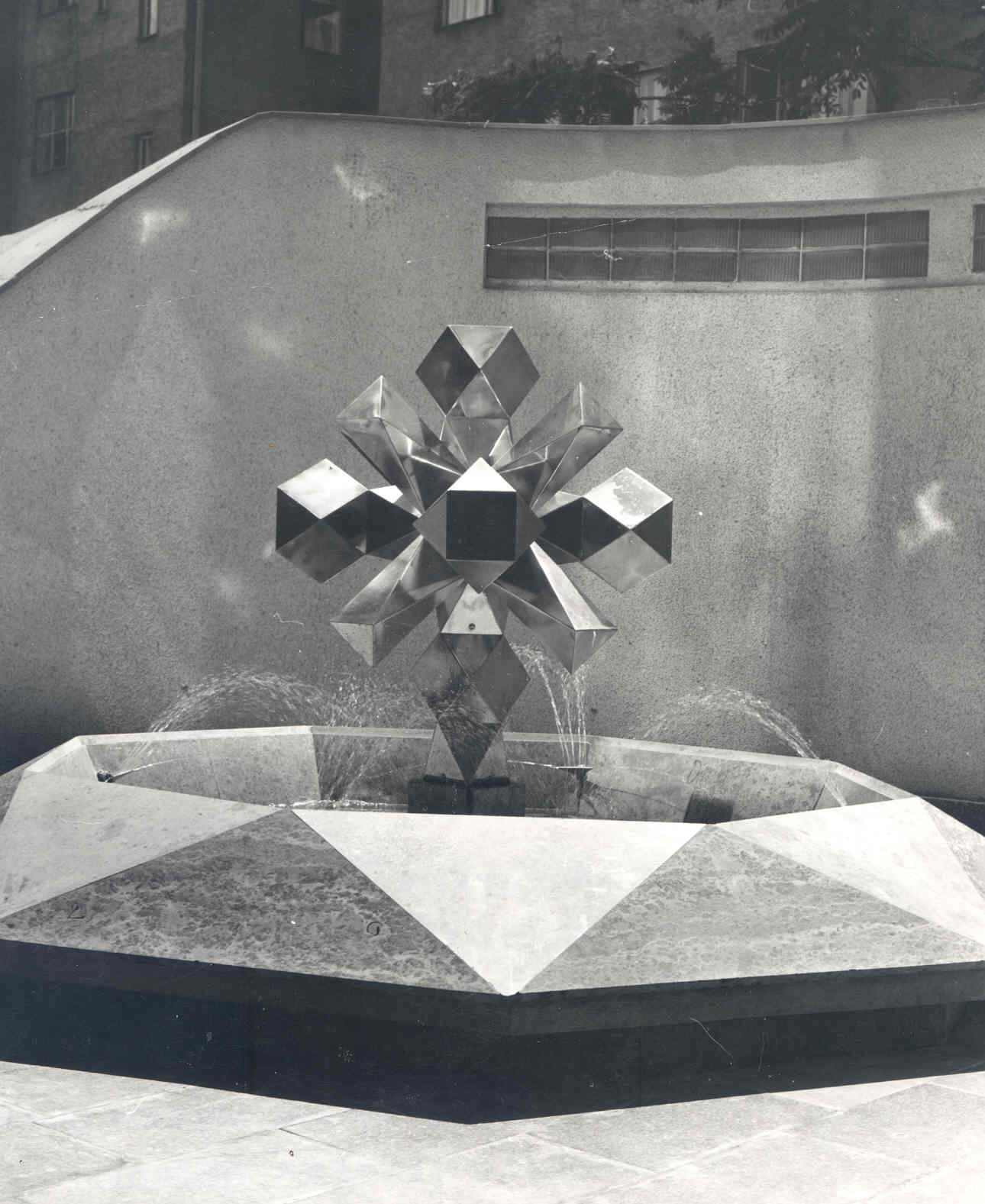
Architect K. Paluš had planned space for a striking work of art to be mounted between the tall windows on the left of the bank’s façade. Sculptor A. Trizuljak created a tall vertical relief formed from polished metal specifically for the location; at first glance, it appears to be flowing down the façade. From closer, it resembles a mysterious urban structure, perhaps inspired by Verne’s Steel City. Although a significant portion of the complex was built as early as 1974, it was not completed for a further three years. The metal relief was installed in 1977, the same year that a fountain by K. Paluš was added to the atrium between the bank and the apartment building.
This impressive work of art has remained on the façade through various changes in ownership and usage of the former bank building. It is neglected and dirty, however, as is the entire once-impressive façade. Cars parked nearby block the view of the relief. At some point, a fire hydrant was installed directly beneath the relief, the door of which touches the relief and disrupts the original clean composition of the work against the smooth façade. This insensitive approach is "crowned" by weeds that sprout from cracks between the façade and the car park. The former entrance to the atrium is currently gated off, further detracting from the building’s appearance, and an interesting relief by a prominent Slovak artist, designed to be seen by everyone, remains almost overlooked on its façade.
ZD
Research status as of 30. 04. 2024.