Multi-genre artist Július Satinský (1941–2002) worked as a theatre, television, and film actor, comedian, singer, dramaturge, publicist, and writer. Along with Milan Lasica (1940–2021), they stood at the beginning of the famous Bratislava cabaret Tatra Revue, and as a comedy duo become popular throughout the former Czechoslovakia from the 1960s. Together with the musician and composer Jaro Filip (1949–2000), they created the legendary album Bolo nás jedenásť (We Were Eleven) in 1981, a compilation that has been reissued and performed live many times since.
Július Satinský lived on Dunajská Street in Bratislava for his entire life, making the street famous through articles he wrote from 1996 onwards for the newspaper Staromestské noviny, and, later, for Bratislavské noviny. Selections from his texts have been published as books entitled Chlapci z Dunajskej ulice (Boys from Dunajská Street) and Polstoročie s Bratislavou (Half a Century with Bratislava). He is buried in the historic Ondrejský Cemetery, close to Dunajská Street.
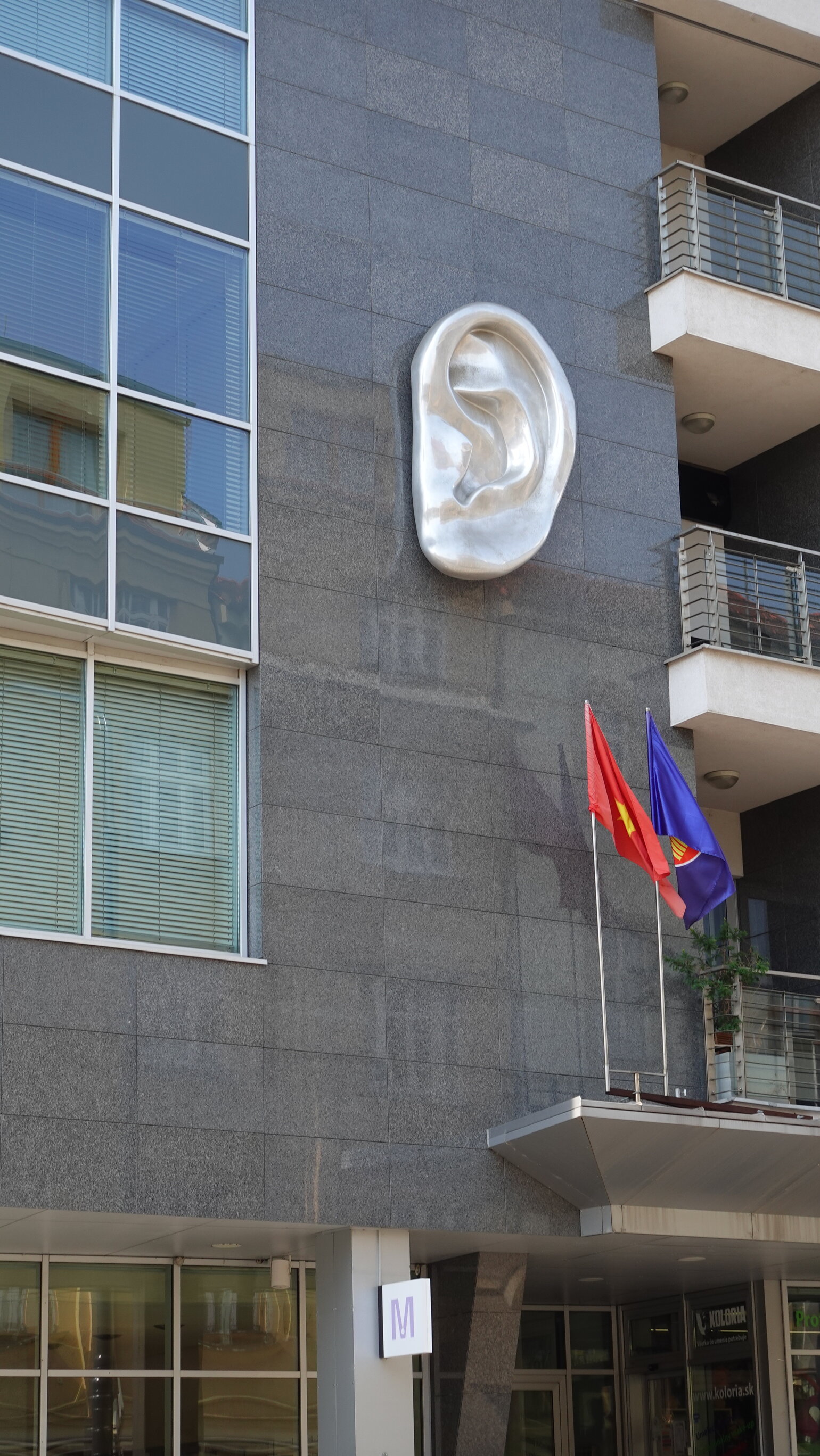
On 24 September 2006, shortly after the fifth anniversary of his death, a statue of J. Satinský made of polished steel was unveiled on Dunajská Street. It takes the rather surrealist form of a walking table and wavy tablecloth supporting a half-figure representation of Július Satinský. With his right hand, he points up towards an oversized metal ear (Oracle) on the façade of a building. He cups his left hand to his ear as he listens to the sounds around him. At the front of the table, stylised handlebars and a headlight are aimed at a bronze plaque mounted on a stone base. The plaque bears a quotation from Julo Satinský: There is freedom on our street.
With its proportions and high gloss, the statue dominates the centre of the pavement, and its "mirror" surface can create an unpleasant glare on sunny days. More than 17 years after its installation, however, people have become accustomed to it. It serves as an unsentimental reminder of the connection between Dunajská Street and the life and work of Július Satinský. Fortunately, the statue never became a place for depositing plastic lanterns, live or artificial flowers, or numerous commemorative items, as is the case with his grave in the nearby Ondrejský Cemetery.
ZD
Research status as of 30. 11. 2023.