Tomáš Garrigue Masaryk (1850–1937) was a versatile and influential philosopher, humanist, sociologist, university professor, journalist, and politician. Together with Milan Rastislav Štefánik and Edvard Beneš, he was one of the most important founding figures of the first Czechoslovak Republic (ČSR). Shortly following its creation in 1918, he was elected the inaugural president of the joint state. Prague Castle became the primary presidential seat. Masaryk visited Bratislava, the administrative and cultural centre of Slovakia, for the first time as president on 19 September 1921. After his death, the name T. G. Masaryk remained in people's memories as "father", founder of the democratic state, even during the difficult periods of the Second World War and then socialism. Such remembrance was not officially encouraged, however, neither in the 1950s nor following the onset of harsh normalization in the 1970s. The political establishment of the then Czechoslovak Socialist Republic (ČSSR) sought to consign Masaryk, Štefánik, and the memory of the first joint republic of Slovaks and Czechs to oblivion. Fortunately, this was unsuccessful, and in 1988 a Memorial to Czechoslovak Statehood was erected in front of the Slovak National Museum (SNM). It took the form of a commemorative plaque and a pillar with the symbolic statue of a lion holding the state emblem. This was a compromise, as the lion originally formed part of the monument to M. R. Štefánik created in 1938 by Bohumil Kafka, which had been removed in the early 1950s. After November 1989, Czechoslovakia once again began to embrace the democratic legacy of the first Czechoslovak Republic, and initiatives arose in Bratislava to create or restore monuments to Masaryk and Štefánik. This failed to materialise before the country's division in 1993, and the situation became even more complicated during the following years.
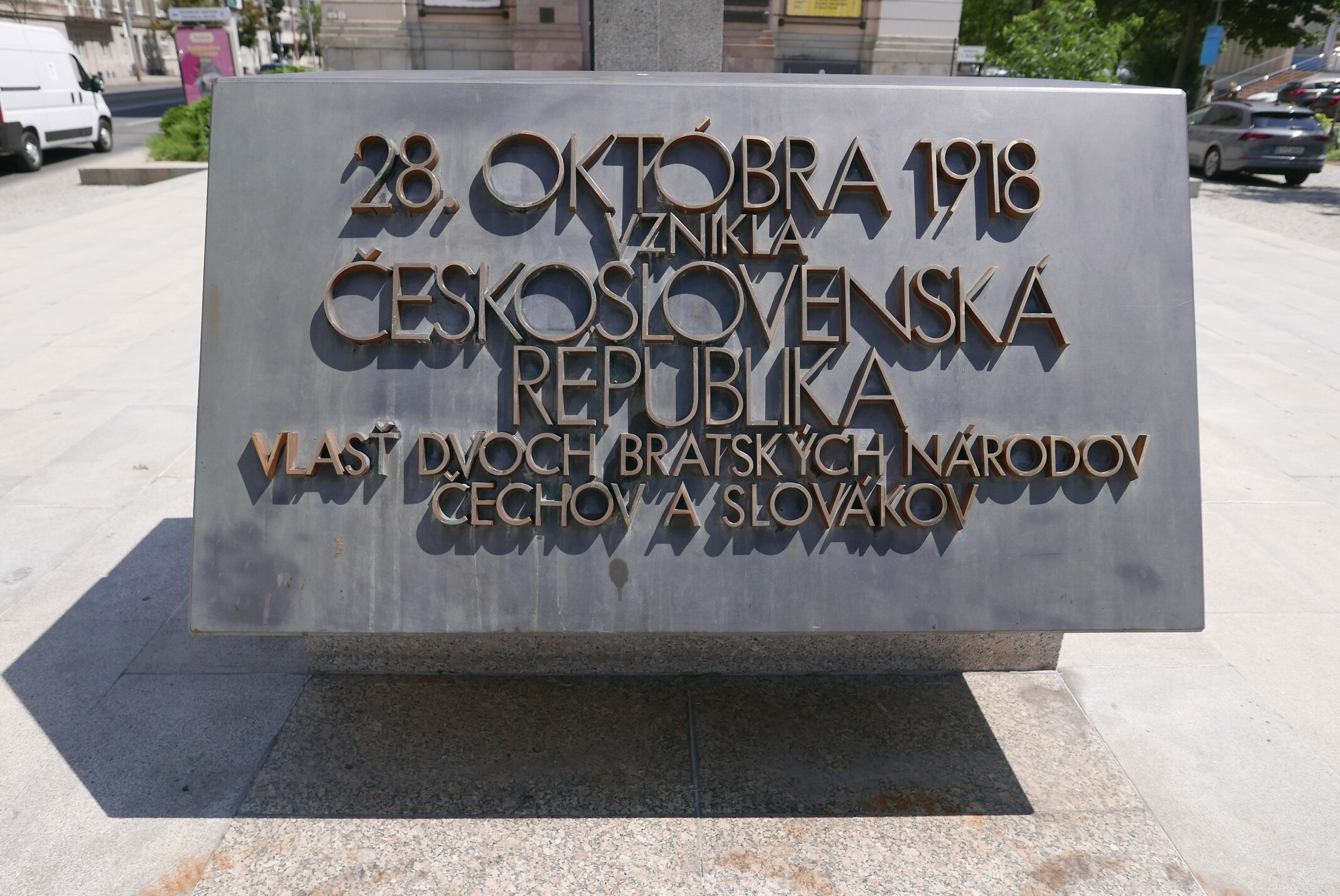
In 2010, on the occasion of the 160th anniversary of his birth, the statue of T. G. Masaryk was erected on Vajanský Embankment in front of the Slovak National Museum headquarters. In 2019, through an initiative by the Old Town district and several MPs and supporters, the modest space in front of the museum was named T. G. Masaryk Square. As with the lion, the statue of Masaryk in the square represents a compromise. The work was not designed specifically for this space; it comprises a replica of a 1924 sculpture by the renowned Czech sculptor L. Šaloun. Masaryk, depicted in a slightly striding posture, is wearing a long coat and holding a scroll in his lowered hands. This creates an interesting parallel with the monument to M. R. Štefánik, where Štefánik is also depicted with a scroll in his hand. The statue of Masaryk was originally located in the lobby of the Czechoslovak 'Bank of the Land' (Zemská Banka), construction of which began in 1922 based on a design by the architect Osvald Polívka. During construction, Evžen Linhart modified the project into a more modern form. The statue’s somewhat larger-than-life size is proportional to its original location in the bank. The bank's representative building still stands on a plot between Laurinská and Gorkého streets. Although it currently serves a different purpose, allegorical stone sculptures, as well as works by L. Šaloun, have been preserved on its facade. Masaryk's statue had a further complicated history. During the Second World War, it was hidden in a boiler room beneath a heap of coal, and after several vicissitudes it arrived at the Bratislava City Museum (MMB) repository, remaining there for decades until its rediscovery. The original is still in the repository. According to Šaloun's design, the statue was cast by the well-known Czechoslovak company Franta Anýž. For the outdoor installation, the artist Jaroslav Matějíček (Matějček – Wallner, Veverské Knínice, Czech Republic) created a replica of the statue, donating a cast of Masaryk's signature along with it. As part of preparations for installation of the statue, the tall pillar with the Czechoslovak lion was removed from in front of the museum, leaving only the lower block with a bronze plaque bearing the inscription: 28 OCTOBER 1918 / THE CZECHOSLOVAK REPUBLIC WAS ESTABLISHED / THE HOMELAND OF TWO BROTHERLY NATIONS / THE CZECHS AND THE SLOVAKS. The lion was moved to the embankment near the Eurovea complex where it again became part of the M. R. Štefánik monument rebuilt in its new location.
The square’s current form is therefore a compromise resulting from several architectural and construction modifications, and the installation, removal, and demolition of statues and pedestals. In 2019, the rear of the pedestal of the T. G. Masaryk statue was augmented with a marble plaque inscribed: MAN CAN ENDURE MUCH IF HE HAS A GOAL / BRATISLAVA-OLD TOWN / MMXIX, together with a facsimile of his signature. The latest modification involved paving a section of the square with stone cubes.
Research status as of 30. 06. 2023.
ZD