During the Second World War, the Danube Flotilla was a military unit of the Red Army. It participated in the liberation of countries along the River Danube, from its mouth in the Black Sea to Austria (Vienna).
The memorial has a symbolic shape reminiscent of a ship's keel. The original idea was that the work would depict a ship's prow with the figure of a sailor and would be partially submerged in the Danube. This idea proved too grandiose and could not be implemented in the given location of the Danube port.
The conical monument with a relief frieze evoking the river's flow bears an inscription in Slovak and Russian. Similarly to other period works of its type, it contains a historical error in referring to the Soviet Army instead of the Red Army (its official name until October 1946).
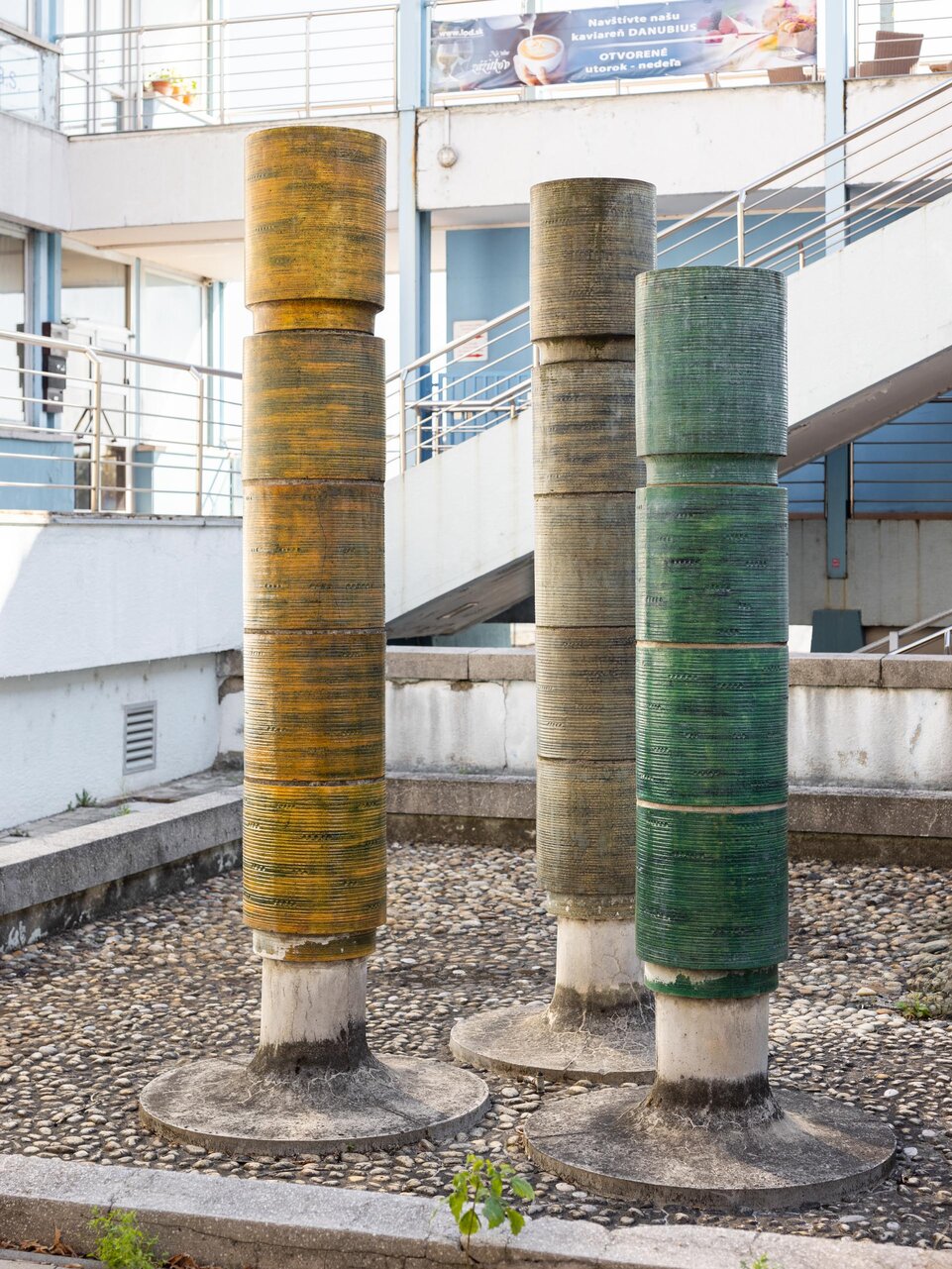
The memorial is located within a triangular corner plot beside the Passenger Port, a building from 1967 designed by the architect Valéria Triznová. The composition also features five low cylindrical columns, their shape and location resembling “bitts”, quayside posts used for the mooring of ships. The overall art-architectural design of the work is therefore symbolic of ships, sailing, and the River Danube.
ZD
Research status as of 30. 06. 2023.