The First Czechoslovak Republic (ČSR), a joint democratic state of Czechs, Slovaks, and other nations and nationalities, was established on 28 October 1918. In the complex political situation of the end of the First World War and collapse of the Austro–Hungarian Empire, this was not a straightforward process. The struggle for the republic continued throughout the subsequent period, but the date of 28 October remained officially recognised and became a public holiday. The celebration of the founding of the first Czechoslovak Republic was interrupted in 1938 following the Munich Agreement and subsequent events. During the Second World War, Czech and Slovak relations and politics continued in the form of the anti-fascist resistance and government-in-exile. After the war, the joint republic was restored, but the founding date of the first Czechoslovak Republic was overshadowed by other "holidays" promoted by ideologues of the time. In the aftermath of 1948, 28 October was designated as Nationalisation Day, and instead of celebrating the founding of Czechoslovakia it became a celebration of communist practices. During the more relaxed 1960s, and following the adoption of constitutional law on the Czechoslovak federation, more references were made to the history of Czechoslovakia, at least for a short period, but these were mostly in general terms and did not directly acknowledge the democratic principles of the first Czechoslovak Republic and its founders.
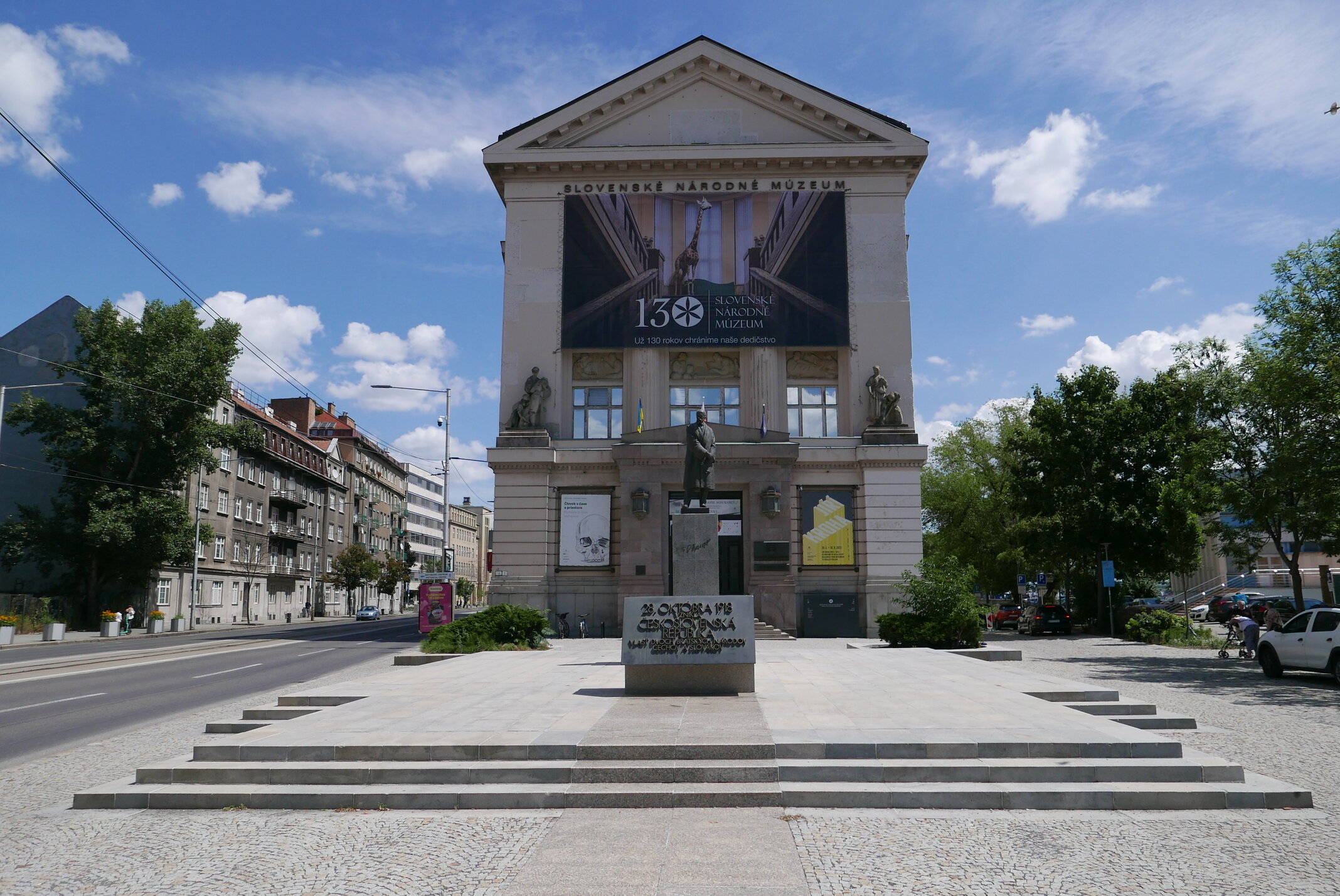
In Bratislava, efforts at dignified commemoration of the founding of the joint state were not fulfilled until the end of socialism, and even then only partially. In 1988, marking the 70th anniversary of the founding of Czechoslovakia, an unusual monument was erected in front of the Slovak National Museum (SNM) on Vajanský Embankment. Its form was inspired by the monument to Milan Rastislav Štefánik by the sculptor B. Kafka that was sited at the centre of today's Štúr Square in 1938, but which did not remain in its original state for long – in 1940 the statue of a lion with the national emblem was removed from it, and in the early 1950s the statue of Štefánik was taken down. In 1988, the architect I. Salay reinterpreted the monument’s original composition, but without the Štefánik statue. A restored statue of a lion with a modified national emblem was placed on a tall reinforced concrete pillar clad with grey stone. The lower section of the monument comprises a stone-clad block with a bronze plaque that bears the inscription: 28 OCTOBER 1918 / THE CZECHOSLOVAK REPUBLIC WAS ESTABLISHED / THE HOMELAND OF TWO BROTHERLY NATIONS / THE CZECHS AND THE SLOVAKS. The new monument soon became an attraction and a popular destination, and not only during celebrations. The dominant statue of a lion on a tall pillar inspired various colloquial expressions, as people agreed to meet "under the lion", "under the tail", and such like.
The tradition of celebrating the first Czechoslovak Republic on the square "under the lion" continued even after November 1989. Following removal of the pillar and relocation of the lion to the restored monument to M. R. Štefánik beside the Danube, the modified Masaryk Square remained the venue for official celebrations of the founding of Czechoslovakia. The current Memorial to Czechoslovak Statehood was erected in 2010, and comprises two elements set on a raised stone plateau. Of the original work, the lower block with slanted bronze plaque bearing the inscription remained, and a statue of T. G. Masaryk, the first Czechoslovak president, was placed separately behind it. It is a replica cast of a 1924 work by the Czech sculptor L. Šaloun that stood in the lobby of the 'Bank of the Land' (Zemská Banka). The statue of T. G. Masaryk was designed for an interior space, and its dimensions were chosen accordingly. It is somewhat lost in an outdoor space, especially when viewed from the front against a backdrop of the imposing facade of the SNM with its large sculptures and reliefs. The Masaryk statue has its own entry in the Bratislava City Art database, where its eventful history is described in detail.
At first glance, the Memorial to Czechoslovak Statehood may not seem particularly remarkable. Closer examination of the circumstances surrounding its creation, changes, unimplemented proposals, and other vicissitudes, including ongoing efforts to remove it, reveal it as an accurate reflection of our society.
ZD
Research status as of 30. 06. 2023.