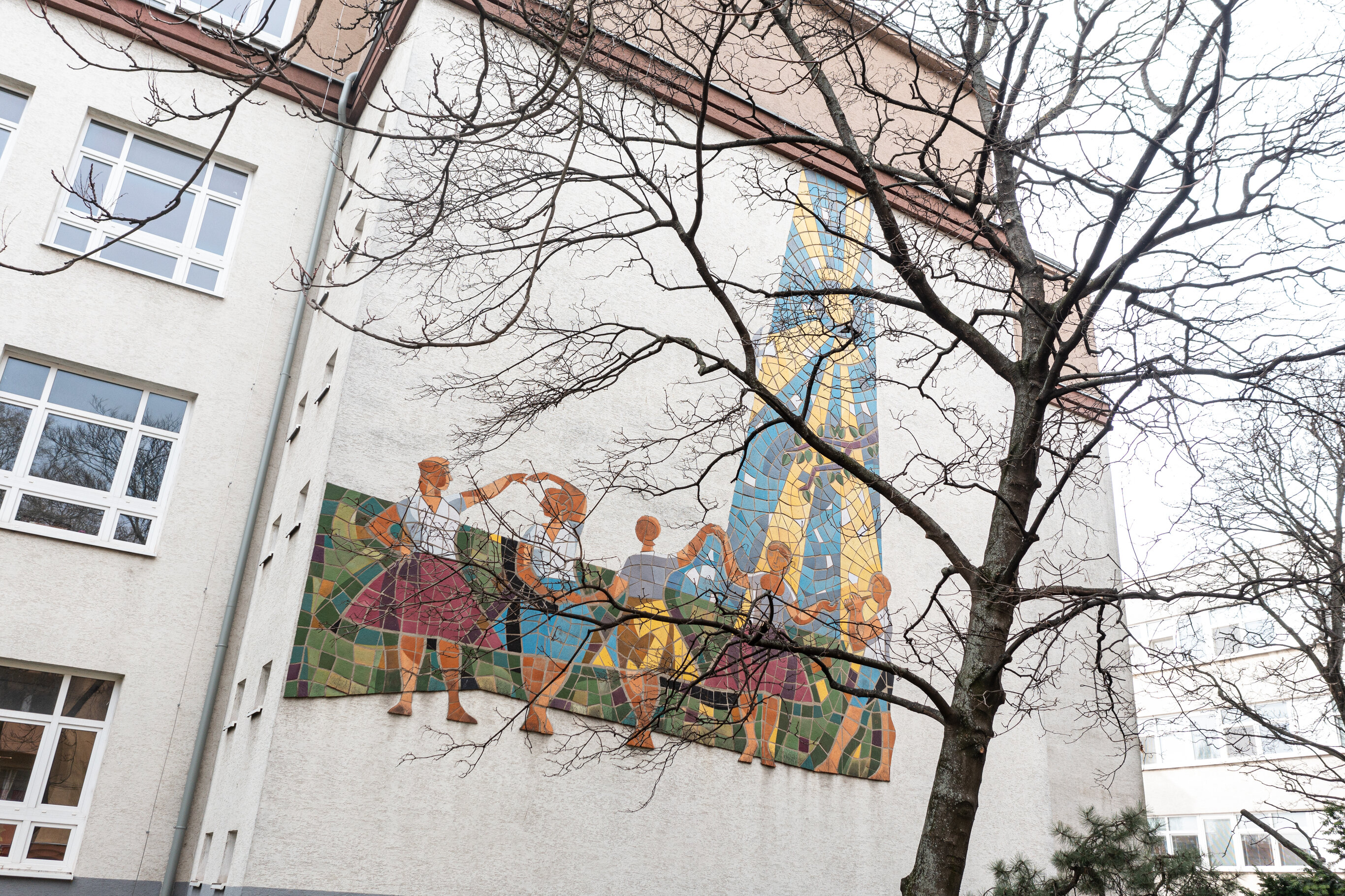
The large-scale glass mosaic composition is located on the façade of a building that houses a primary school and preschool; the building originally served as a sports secondary school. It is situated on a large section of the façade facing the inner courtyard and towards the sports fields. Given its monumental scale, it was intended primarily to be viewed from a distance.
The building was designed by the architect Manol Kančev. He is best known as a designer of school facilities, on most of which he collaborated with artists who enhanced the façades with monumental works, primarily mosaics. He worked with the artist M. Šimurda on several occasions, and chose to install this mosaic on a cantilevered section of the building that is supported by two columns.
On a symbolic level, the mosaic references the school's function and fundamental message. The righthand side of the composition is devoted to sporting activity, suggested by the depiction of darts in a dartboard and a figure in motion below it. The lefthand side features general motifs related to education, such as the capital letter A from the Latin alphabet, the symbol for the Greek letter phi, as used in art and architecture to denote the golden section, and a depiction of the capital of an Ionic column from ancient Greece. In an educational context, these symbols may represent timeless values such as knowledge, education, and harmony.
Despite its distinct elements, the composition retains a largely surreal, dreamlike character. It features abstract forms reminiscent of cutouts arranged in the style of a collage. From a formal perspective, the mosaic draws on the Brussels style that was popular at the time and which was characterised by rounded lines and curves, light and airy details, and a tendency towards abstract forms. The work is also the culmination of the artist’s intimate paintings from the 1960s translated into glass mosaic.
Interestingly, in historical documents this mosaic was referred to as a “fritted” mosaic. In his monograph, Šimurda himself referred to the “fritted Jablonec” mosaic. It is in fact a sintered architectural mosaic measuring 20 × 20 mm that was manufactured in the area of Jablonec nad Nisou. The term “fritted” derives from the word “frit” – crushed feldspar glass, the basic component of this type of mosaic. The mosaic tiles were not set directly into the plaster, but onto a sculpted panel that protrudes from the façade and assumes a relief-like appearance.
After almost sixty years without maintenance, the work continues to retain its striking colours and vibrancy, which serves to confirm the high technical quality inherent in the mosaic tiles.
NB
Research status as of 31. 03. 2026.