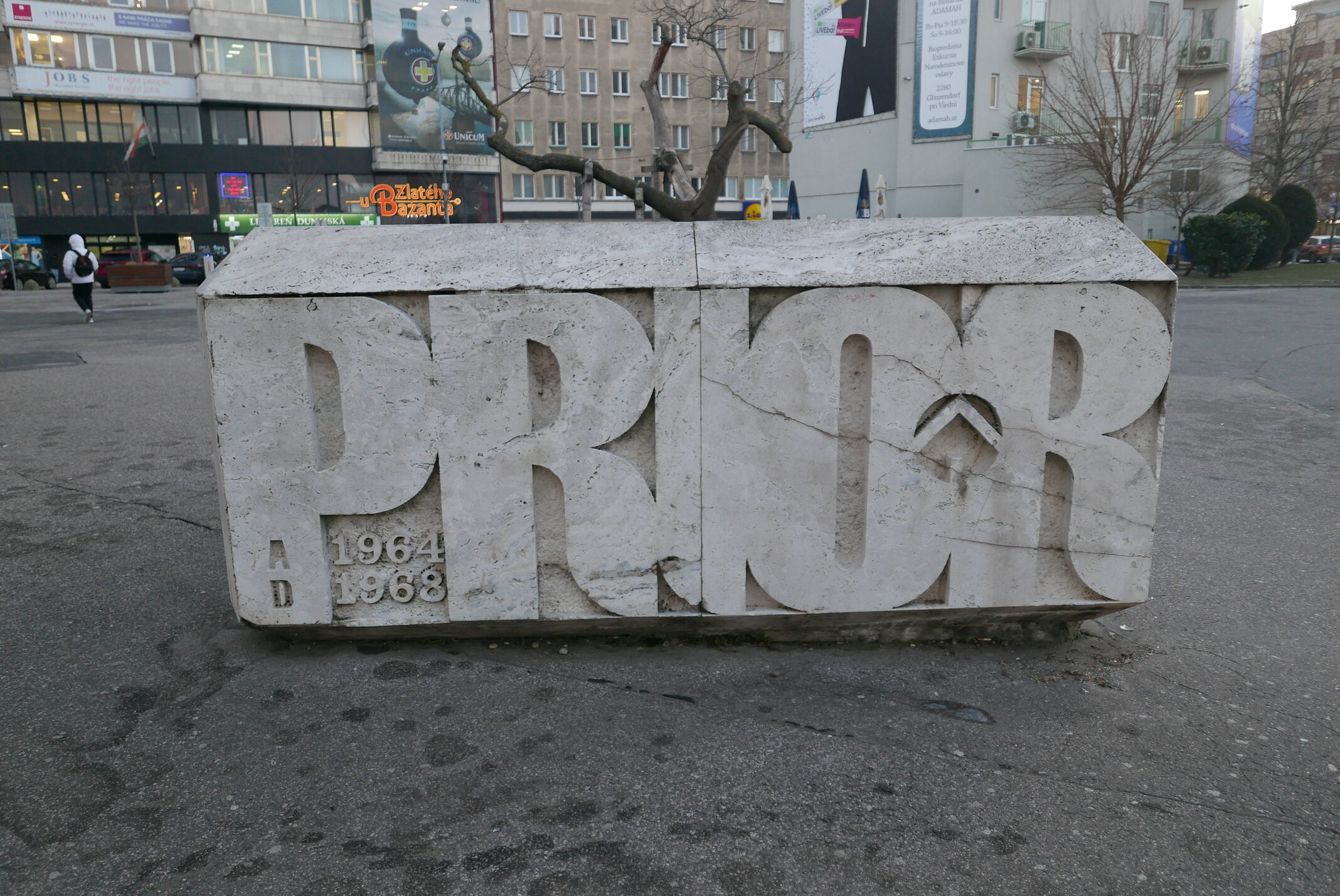
The now destroyed large-format mural was located on the façade of an apartment building on Dunajská Street, adjacent to the Prior department store. The apartment building, along with others on Dunajská, Rajská, and Cintorínska streets, formed part of the original urban fabric of earlier periods. A requirement to preserve them was included within the terms of the 1960 urban planning and architectural competition for the redesign of Kamenné Square. The aim was to ensure that these relatively new apartment blocks were "lived out" before their final demolition. They survive to this day. Unfortunately, their disjointed style creates a sense of disharmony in the urban landscape and in the overall composition of the complex.
Perhaps for this reason, in 1987 there were plans to enhance and aesthetically improve the bustling Kyjev Square (now Kamenné Square). An abstract decorative mural was installed on the prominent gable wall of the apartment building to bring a splash of colour and optimism to the area, as well as to serve as a landmark within the Bratislava I district. The work was created as part of the preparations for the 70th anniversary of the October Revolution.
The abstract form of the mural featured stylised renderings of ornamental motifs that celebrated peace and care for the environment. Its dynamic, colourful composition of doves of peace and falling leaves represented universal values of harmony and joy, themes typical of most murals on the façades of apartment buildings. These concepts were conveyed through a range of familiar symbols and motifs that included dancing figures, flowers, the sun, doves, musical instruments, and various combinations thereof. Despite the conservative nature of the subject matter, these works often displayed a bold approach to abstraction and stylistic simplification in their formal execution.
From the perspective of art of the period, monumental murals continued to be created on building façades until 1989 under the provisions of Chapter V. In addition to Š. Bobota, professional painters such as Ivan Vychlopen, Peter Günther, and Ján Ilavský were involved in such works. Most murals from this period have not survived, many having been painted over. In the mid-2010s, muralists revived the somewhat forgotten ethos of monumental painting in architecture by creating large-scale graffiti on building walls (see the entry “Hotel Kyjev Deconstructed”).
In the Old Town alone, the artist created several other murals, including on Štefánikova, Križkova, Špitálska, and Gunduličova streets.
NB
Research status as of 23. 07. 2024.